A dated document is worth more than a confident opinion.
Anyone can explain a change once it has happened. In the early part of the 2010s TEN3 published two short papers saying what was coming, and they are reproduced here in full, at the bottom of this page, so you can judge them yourself rather than take our word for it.
They are not impressive documents. They are four pages and three pages, written plainly for school administrators, with hand-drawn diagrams. That is rather the point: the argument did not need to be clever, it needed to be right about the direction.
Some of it was right, one part of it has been overtaken, and one call has gone the other way so far. All three are set out below, scored in a table. The part we got wrong turns out to be the most useful thing on this page.
The industrial model is not working.
A school year, a class of thirty, a fixed syllabus delivered at one pace, and an artefact collected at the end to prove it arrived. That design was not handed down from antiquity. It was built to educate large numbers of people affordably, and it did.
It was already straining before anyone had heard of a large language model. Students arrive at university unable to read a complex argument and carry it; employers say the same thing about graduates every year; and everybody's proposed remedy is another layer of measurement laid over the same machine.
Everything in these two papers follows from one observation: when the scarce thing changes, the institution built around the old scarce thing stops making sense.
Universities exist because knowledge was rare and expensive to reach. You went to where the books and the scholars were, because there was no other way. The second paper says this outright — "the rare resource then was knowledge rather than equipment" — and it was written before knowledge became free to anyone with a connection. That is the whole argument, and artificial intelligence has only finished the job the Internet started.
The credential comes loose from the school.
The first paper's claim was that education was moving to a test-based system — that what would matter is the exam a person can pass, not the institution that walked them to it.
It began by drawing the arrangement everyone knew. A student climbs: primary school, then an exam, then secondary, then another exam, then university, and only then the professional certification. Every step is gated by the step below it, and the school controls the gate. The paper noted one exception already visible at the time — a technical certification like the A+ could be taken by anyone who could pass it, straight from primary school, with no institution's permission at all.
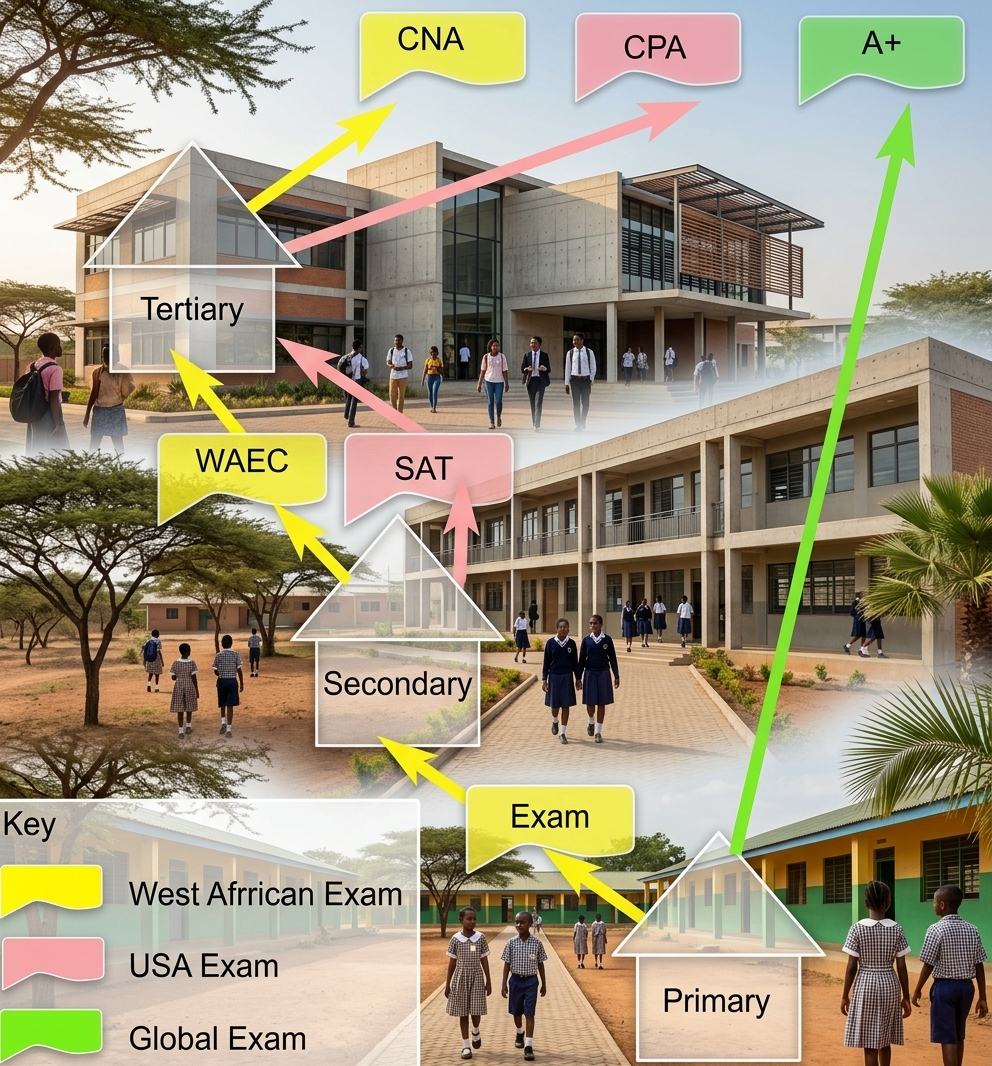
Then it named the thing that would break the arrangement, in a sentence that reads very differently now than it did then: "The Internet is opening up the opportunity for people to study on their own and pass exams."
If that is true, the paper argued, the institutions stop being the road and become optional stops beside it. A student would not need a secondary or tertiary diploma to sit the exam that actually gets them work. It gave a concrete example: the California application to become an Investigative Certified Public Accountant asked for the "equivalent to graduation from college" — not graduation itself. And it pointed out that in living memory, medicine and law were both entered by examination and apprenticeship rather than by degree.
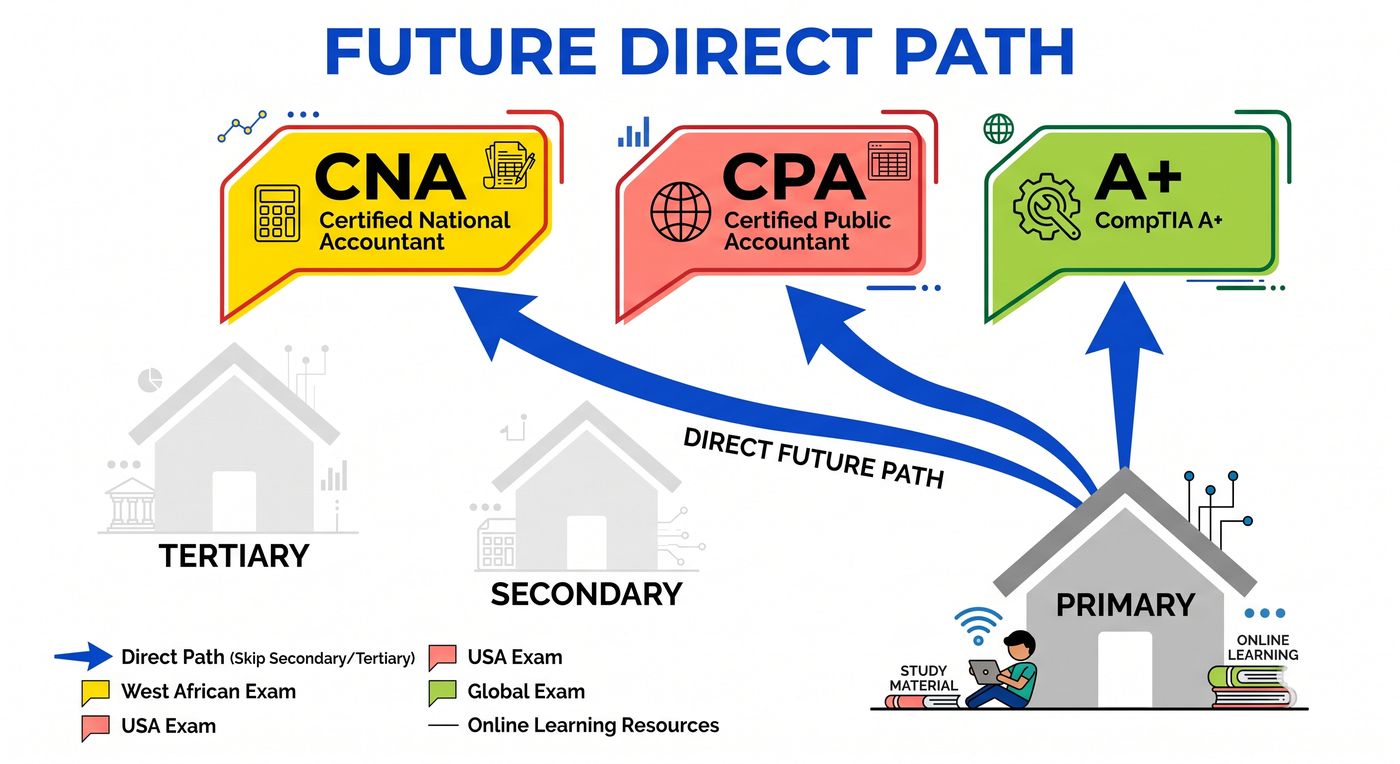
From that one shift the paper drew the consequence that mattered to a school, and it is the sentence worth carrying away:
"We know that for a school to succeed in the future, they are going to have to show 'value-added' to the prospective students, or they will not have students."
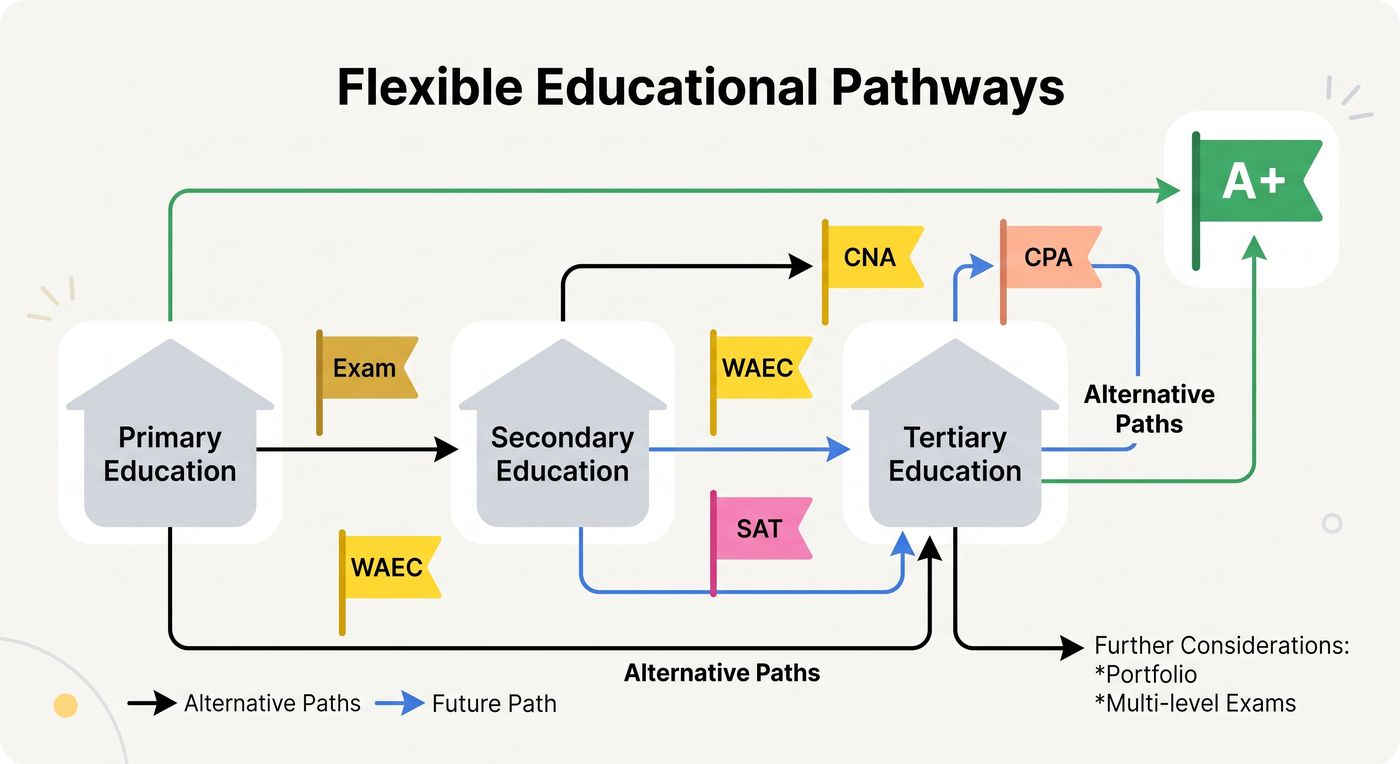
Its third diagram put the two pictures together, and this is where the paper is at its sharpest. The tables turn. Students stop struggling to pass a test in order to be let into the next institution; institutions start working to attract students who no longer need them. Both routes exist side by side, and the school's job changes from gatekeeping to being demonstrably worth attending. The paper also listed, almost in passing, the two things it expected schools to need: portfolios of the student's actual work, and exams arranged in levels. One of those has since been overtaken, and it is the subject of the scorecard below.
Then the second paper said what a school should do.
School Response refused the obvious answer. The obvious answer in the 2010s was to chase science and technology, and to buy back the timetable hours from art, history and reading.
The paper called that more damaging than the Internet, on the grounds that the mind runs on language and thinking is tied to stories — so a curriculum that trades away language to make room for technique produces students who cannot sustain a long thought about anything, technical subjects included.
Its recommendation for primary school was the opposite: build language and reasoning first, integrate science into exploring the world, and do not begin formal mathematics until around grade five, citing Bénézet's experiments in which arithmetic taught later was learned faster and understood better. Stated plainly, its aim for a primary school was that "the student should learn to read, reason and have a relationship with Christ, their Creator."
And for secondary school it put one thing underneath everything else. A school may specialise — pick which exams it prepares students for, and treat that as its niche in the market. But nothing it offers stands up without the layer beneath.
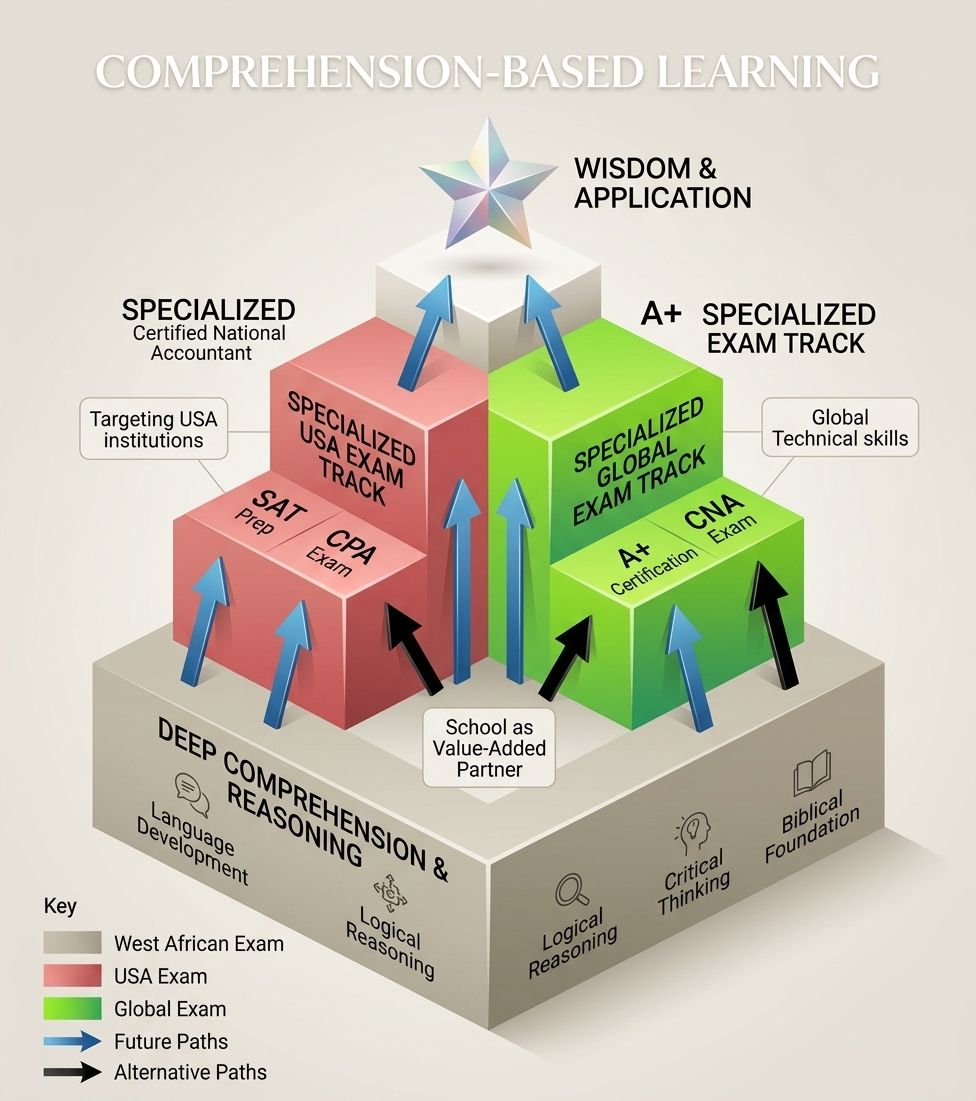
And the second paper named the failure precisely, in a sentence that has aged better than anything else in either document: "Students learn to read and can tell you what they read, but they do not know what it means. They have no idea how to apply information usefully."
What we called, and what became of it.
Six claims, scored. Two held, one is partly there, one turned into a programme we now publish, one has been overtaken by events — and one has gone both ways at once.
| What the papers said | Where it stands | Verdict |
|---|---|---|
| A school will have to show value-added to prospective students, or it will not have students. | Held, and artificial intelligence has made it acute. The thing a school used to add — delivery of knowledge — is now free and available at any hour. Whatever a school is for, it is no longer that. | Held |
| Comprehension is the base beneath every qualification, and its absence is the great weakness of education in Africa and the West alike. | Held, and sharpened. A machine now produces prose that reads exactly like comprehension and contains none, so the deficit is far easier to hide — and genuine comprehension is worth more than it has ever been. | Held |
| Credentials will come loose from institutions: people will learn on their own and sit the exam without a school's approval. | Partly. Employers and several United States governments have dropped degree requirements from large numbers of posts, and certification routes have grown. But the degree still dominates hiring, and the wholesale bypass the paper drew has not arrived. | Partly |
| Primary school should build language and reasoning first, with formal mathematics delayed to about grade five. | We stopped arguing it and built it. That recommendation is now a published curriculum with practice activities, in use, free, and working offline on a phone. | Built it |
| Electronic portfolios of the student's actual work will be part of the answer. | Overtaken, and this is the one worth dwelling on. A portfolio is evidence only while producing the work is hard. Producing became free, so the artefact stopped being proof of the person who submitted it. | Overtaken |
| The SAT will have to change what it is, or be dropped. | It went both ways. Most of the sector moved away from the tests and the largest public system in the United States abandoned them outright, while a small group of highly selective private universities brought them back. See below — the split is more interesting than either half. | Split |
The overtaken row is the most valuable line in the table. TEN3 named the problem in the 2010s, proposed the portfolio as the answer, and the same organisation now says plainly that the portfolio is no longer sufficient. The evidence has had to move off the artefact and onto the student — which is what the fifth entry of Build a Wisdom Centre is about. We would rather be corrected than consistent.
The tests split the sector in two.
A footnote added to Educational Direction around 2020 reads: "the SAT has not morphed and universities are beginning to drop the SAT as a requirement." Since then the picture has divided.
Most of the sector did move away. Hundreds of institutions went test-optional, and in 2021 the University of California — the largest system of its kind in the United States — went further and stopped considering the scores at all. Then a small group of highly selective private universities went the other way and reinstated their requirements: the Massachusetts Institute of Technology in 2022, and Dartmouth, Yale, Brown, Harvard and the California Institute of Technology in 2024.
So the score is split, not reversed. The reinstatements are the visible half because of who made them rather than how many.
A reinstatement shows that a university found the score useful for sorting the applicants in front of it. Whether the thing the score measures is still the thing that matters is a separate question — and it is the one these papers were asking.
The distinction is between logic and reason, and it is worth naming because it recurs everywhere in this argument. Logic is the machinery for getting validly from one statement to the next; it never breaks. Reason is that machinery plus the commitment to check whether what you fed into it is true. An argument can be perfectly logical and still absurd — all spiders have eight legs; my dog is a spider; therefore my dog has eight legs — because the wiring was flawless and nobody inspected what it was plugged into.
Reinstating an entrance test is a valid inference from the premise that scoring high measures the scarce and valuable thing in a person. That premise held for a long time. It is precisely the premise artificial intelligence has taken away: the machine outscores every student any of us will ever teach, at recall, at speed, at pattern-matching, and it does so for a fraction of a penny. What the test measures is exactly the capacity that has become cheap.
An institution can run a flawless argument for years on a premise it has stopped going upstairs to check.
Those universities may well be right about the applicants in front of them this year. The longer question is a different one, and our answer to it is an argument rather than a fact: a test of the cheap thing is unlikely to stay at the centre of admissions once everyone can buy the cheap thing. We said the SAT would have to change what it is or be dropped. We were early, and part of the sector has gone the other way.
Artificial intelligence did not alter the direction. It removed the delay.
Everything in these papers turned on one thing becoming cheap: reaching knowledge. The Internet made it cheap to find. Artificial intelligence has made it cheap to have — explained, adapted to the reader, at any hour, in any language, and patient.
The gap between the two papers and now is not a change of argument, it is a change of pace. A shift that looked like a generation of slow institutional drift is arriving inside a single cohort's time at school. A school that planned to think about this after the next strategic cycle has already missed it.
Three consequences follow, and each one lands on something the papers named:
The exam is not safe either. The papers imagined the exam as the stable thing that institutions would come to orbit. But an exam is also an artefact produced under conditions, and the same machine that broke the essay is quite capable of sitting a remote test. What survives is not the exam; it is whatever cannot be produced by something other than the person being asked.
Comprehension moved from a weakness to the whole game. When the machine will write the paragraph for you, being able to say what a thing means, in your own words, with the machine switched off, stops being a school virtue and becomes the only thing a qualification could honestly certify.
Value-added has one obvious answer now. If delivery is free, what a school adds is the part no machine supplies: real work with real consequences, someone experienced watching you do it, and a person who will sit beside you and find out what you actually hold. It is what these two papers were pointing at, arriving faster than they expected.
Grading by listening is the older thing.
Examination by conversation is what assessment was before we industrialised it.
Socrates did not collect submissions. Aristotle's students were not marked on documents. For most of the history of education, finding out what someone understood meant asking them and listening to the answer, and the written artefact submitted for marking is the recent innovation — adopted because it scales, at exactly the moment schooling needed to scale.
The machine has not driven us somewhere strange. It has removed the reason we ever left. We accepted the artefact as a proxy for the person because asking each person was expensive. The proxy has failed, and the original method is waiting where we left it.
It is still expensive. Two things pay for it. The first is that the hour spent delivering knowledge is an hour that no longer has to be spent that way, which is where the time comes from in Build Your Own AI Policy. The second is structural: put students in a room doing real work under supervision all week, and the conversation costs nothing extra, because the person who would conduct it is already sitting there. That is Build a Wisdom Centre, and the two papers on this page are why it exists.
The two papers, as written.
Both were produced in the early part of the 2010 decade and circulated to school administrators. They are reproduced here in full. Three obvious typographical slips have been corrected and nothing else has been changed; the diagrams above are new renderings of the originals, drawn so they can be read on a phone.
Educational Direction
This is an extremely short paper giving the broad-strokes of the direction of education today. This is neither an explanation nor an evaluation, but simply a compass to help in planning, and it will have implications for all your school's programmes.
In order to meet the global educational needs in an affordable way, education is rapidly moving towards a test-based system.
In the current setting, a student progresses from primary school to secondary to tertiary (also known as university). In West Africa, there is an exam to get from primary to secondary school. In both the USA and West Africa, there is an exam from secondary to tertiary. After tertiary, students can move toward exams, such as the CNA (Certified National Accountant) or the CPA (Certified Public Accountant). We've not shown any exams directly from secondary school, but they do exist. We did show that the A+ technical certifications are available straight from primary school, if the person is able to acquire the knowledge to pass it.
The Internet is opening up the opportunity for people to study on their own and pass exams.
As education goes more global, passing the exams will be all that is required, without educational institutions' approval. Students could get books and Internet material to learn on their own what they need to pass the exams. There most likely will be exams in between primary school and a CPA, but not necessarily, and also the student will not need secondary or tertiary school diplomas or degrees to take those exams. For example, in the state of California to become an Investigative Certified Public Accountant the application reads that you need to have the "equivalent to graduation from college." Notice how it doesn't say you have to graduate from college, just the equivalent. This is just one of many examples. In fact, in US recent history we have seen that medical school was not required, rather an exam and apprenticeship was what was required. This was also true to be a lawyer. As schools lose their grip on society, this will become true on a worldwide basis. We can expect it in all fields, changing education drastically.
The tables have turned.
No longer will students be struggling to pass a test to get into the next level of education, such as the WAEC or SAT to get into university, but universities and secondary schools will be working hard to attract students to study at their school. And what would entice a student to pay and go to school if they do not need to? The answer is that the schools have to show they will help the student's performance on the exam they desire to pass.
We've listed other considerations that will be important, including electronic portfolios to show the student's actual work. We've already mentioned that there will be multiple levels of exams, where you need to take one exam before you can take another. For example, if the SAT learns to morph, they could keep themselves in business if they could show they are an important step before a person takes a more advanced exam. However, this will only happen if they see the direction and prepare themselves for it. That is one of the reasons for this paper.
We know that for a school to succeed in the future, they are going to have to show "value-added" to the prospective students, or they will not have students. They will have to show that they can improve the student's chances on the exams that student needs to take.
We will look at the implications of this movement for your school in the next paper.
Footnote 2, added around 2020: "As of 2020, the SAT has not morphed and universities are beginning to drop the SAT as a requirement." This is the call discussed in the section above.
School Response
Primary. The current direction of primary schools is to focus on math, science, and technology, in hopes to prepare the students for this ever-increasing technological age. Since time is the limiting factor for us all, the school curriculum designers need to reduce how much time is spent on art, history and even reading (language).
The problem with this approach is that the mind operates on language, and the thinking process is tied to stories. Because of this, the approach currently being taken is even more detrimental than the Internet to the development of minds that can sustain extended, complex thought.
A primary school should focus on the development of language and of understanding of the stories that developed their world. Science would be integrated into the exploration of their world without jeopardizing the development of language and comprehension. Mathematics, itself, should not be approached until grade 5 but the foundation of mathematics should be established through reasoning giving the children a much higher chance at success in the advanced grades. To put it more succinctly, the student should learn to read, reason and have a relationship with Christ, their Creator.
If this were done, the need for secondary and tertiary education would be reduced radically.
Secondary. It is unlikely that many primary schools will take the path recommended above. Rather, they will continue down the path of teaching the sciences before the mind has been properly developed with language. For this reason, there will still be a need for secondary schools. Furthermore, even if a primary school did follow the above recommendation, some students will not be ready at the end of primary school to progress toward further learning and eventually exams without guidance. This has to do with factors like the maturing process, personality and home environment.
Secondary schools should have a "level" approach.
The great weakness with education today, in Africa and the West, is lack of comprehension. Students learn to read and can tell you what they read, but they do not know what it means. They have no idea how to apply information usefully. This lack of comprehension will make them weak in ability to pass the tests, get the certifications, and apply the knowledge to get work experience.
The most important thing a secondary school can do is to develop a comprehension level where students learn how to comprehend what they read. With that base, the world of knowledge is theirs. And with God's help, wisdom too. From this base, the school can then specialize on the test or tests they want to offer. In business terms, the secondary school picks a niche in the educational market. A student may leave the school after the comprehension level and pursue exams. But some students will prefer to stay in school to get help working toward a particular exam. The school can add specialized exams as they see fit.
In actual practice, the levels are more likely to overlap. There will most likely be exam based topics you want to start the students on earlier before they have the full comprehension done. Further considerations on integration can be considered, but not in a quick overview like this.
Tertiary. Tertiary level will survive via specializations that require rare resources in the educational process. The simple example of this would be equipment that the normal person could not afford in order to study. This is similar to how the original universities developed. However, the rare resource then was knowledge rather than equipment.
If you want to embrace the future of education, you will need to look beyond the technological efforts that are being made by the typical institutions and develop both a philosophy and a strategic plan to move your institutions into the future now with a clear recipe for developing students who can comprehend.
Footnote 2 in the original notes that in the USA the buzz word is STEM — science, technology, engineering and mathematics — which the US Department of Education has treated as the route to "global leadership."
Footnote 3 cites Louis P. Bénézet, "The teaching of arithmetic I, II, III: The story of an experiment," Journal of the National Education Association 24(8), 241–244 (1935); 24(9), 301–303 (1935); 25(1), 7–8 (1936) — and suggests studying the education of Blaise Pascal as an example of waiting on mathematics.
Footnote 4 quotes Michael Gorman, then president of the American Library Association: "It's appalling — it's really astounding… Only 31 percent of college graduates can read a complex book and extrapolate from it. That's not saying much for the remainder." (Lois Romano, Washington Post, 25 December 2005, A12.) The paper draws the conclusion that the remaining 69 per cent are, in its phrase, comprehensively illiterate.
The two papers ended without a method. These do not.
Both papers close by telling a school to develop a philosophy and a strategic plan. That was the right advice and it was not much help, because neither paper said how.
What has been written since is the how, and each piece answers a question these papers left open:
Build Your Own AI Policy — eight decisions a school has to settle about the machine, written to faculty rather than to students, each with wording ready to be used. It is where the question "what counts as the student's own work now?" gets an answer a school can actually apply on Monday.
Build a Wisdom Centre — nine decisions for a department that wants students in real work under supervision, assessed by explaining what they did. It is the "value-added" of the first paper, made concrete, and its fifth entry is where the portfolio is replaced.
TEN3 Primary Maths — the second paper's recommendation about language, reasoning and delayed arithmetic, built into a curriculum with practice activities. Free, and it works with the network off.
Notes on sources
The two papers. Educational Direction and School Response were written and circulated by TEN3 in the early part of the 2010 decade; footnote 1 of each says so. The footnote about the SAT was added around 2020 and is dated in the original. Both are reproduced above with three typographical corrections and no other change.
Admissions testing. The University of California ceased using SAT and ACT scores in admissions following its 2021 decision. The Massachusetts Institute of Technology reinstated its testing requirement in 2022; Dartmouth, Yale, Brown, Harvard and the California Institute of Technology announced reinstatements during 2024. Several hundred other institutions remained test-optional across the same period. These dates should be checked against each institution's own announcement before being relied on, and the claim made here is only that the sector divided — not that either half settled the question.
Degree requirements. Several United States state governments and a number of large employers have removed degree requirements from substantial numbers of posts since 2022. The scale of the effect on hiring is disputed and we make no claim about it beyond direction.
Comprehension. The 31 per cent figure is the original paper's own citation — Michael Gorman quoted by Lois Romano, Washington Post, 25 December 2005 — and is reproduced as the paper used it. It is a statement made in 2005 about United States college graduates, and it is offered as what TEN3 was reacting to at the time rather than as current measurement.
Delayed arithmetic. Louis P. Bénézet, "The teaching of arithmetic I, II, III: The story of an experiment," Journal of the National Education Association, 1935–1936. This is the basis of TEN3 Primary Maths.
Logic and reason. The distinction used in the testing section follows Francis Schaeffer, Escape from Reason, and Nancy Pearcey, Saving Leonardo. Note that "reason" is used here in the older, wider sense — the whole project of arriving at unified true knowledge — rather than the narrower modern usage in which it is close to a synonym for valid inference.
We are always learning. If you see errors or have insight that would help us, please let us know.